The myth of the ever booming methods, machines, and supplements for enhancing fitness, health, and strength is beyond comprehension. Yet, the demand far exceeds the supply. Among fifty or so books I posted for sale, the fitness books flew within hours. The hard science books never left the shelves. Ironically, books that contain enormous wealth of knowledge would not sell for more than few pennies.
On every garage sale or flea market, fitness equipments are resold, brand new, with slim fraction of their retail. And the stories of people purchasing fitness equipments that never left the shipping box are all familiar.
A fellow Lebanese who was fortunate to land on his dream of marrying a blond, Kansan lady and getting a prestigious software position with government defense lab, ventured into purchasing a $4000.00 fitness machines, which he never had a chance to unpack. His sweet heart has never heard of the epidemic of obesity or heart disease. So, she fattened her husband's belly beyond the 44 inches. Like the Greek, most Lebanese are addicted to sweets and fats. My fellow Lebanese, who weighed over 400 pounds, could hardly shoulder-press a 25-pound barbell. Getting him to train on an empty stomach was interpreted as drinking his usual half gallon whole milk for breakfast, leaving the solid foods for later. In his mind, liquid foods were not real food.
While waiting in line behind a man and his ten year old son, in a the gym shop, I paid $1.50 for a bottle of diet Pepsi. The fellow ahead of me has filled the front counter with half a dozen of bottle of supplements that carried the logos of proteins, muscles, and such fancy stuff that promise nutritional gains and enhancement of strength. My educated guess was that the man purchased those nutritional supplements out of genuine belief that it must be something better than alcohol or cigarettes.
Embarking of my early years in strength training, nutrition was a true factor in making some athletes stronger than others. Then, in the 1960's, butter, meat, and milk were all we had as the ultimate source of nutritional supplement. Affluent athletes who had access to those three foods were able to excel ahead of others whose financial situations stood in their way to supplement their high-carbohydrate diet, with protein and fat. Back then, the skim milk was never heard of, neither was the connection between high cholesterol, heart diseases, or lack of exercise. Indeed, those three nutritional foods made many people much stronger than carbohydrate and bean eaters but also shortened the life span of those stronger, meat eaters. We used to joke on such paradox by saying: "Strong people live short life, while feeble ones live longer."
Indeed, it is unquestionable that people with access to nutritional diet and restful life were able to excel in physical fitness far and beyond those with meager means. The simplest explanation is getting the proper fuel to the muscles, the proper nutrients to the nerves and vital organs, then the biological systems could perform its function at its best.
Exercise would only stimulate the body to utilize those available nutrients to build newer and resistant muscles, tendons, ligaments, and bones. Realistically, however, the majority of us are occupied with challenges greater than kitchen tasks or gym training. Most of those kitchen fans have nothing to do with gym lifestyle and vice versa. With the great progress in industrialization, one could easily get a full nutritional meal without the hassles of getting stuck in the kitchen.
That leaves us with the politics of the gym training, the equipments, exercises, and planning. In deciphering the brain of my greatest ever coach, Mohammad El-Kasabbany, I did not have to go far beyond his often repeated statements: legs, lower back, shoulders.
El-Kasabbany gets to the gym by 2:00 pm after getting out of his work as a banker. Within a minute, his training routine was scribed on a leaflet paper, with those three body regions assigned to three segments of the each training session.
The skill of planning a weightlifting routine by El-Kassabany took me thirty years to document in my book :"Essentials of Weightlifting and Strength Training".
The variables played into such scenario were clear and evident.
1. The space was the major determinant in writing any routine. Whenever was changed gyms or equipments we planned accordingly.
2. The weather was another. In the brutal heat of Egypt, we trained even without any water faucets nearby. That was before the era of bottled water. Then, transporting water in bottle was a science fiction topic.
3. Personal development was the greatest player of all. Each lifter developed on different scheme over many years. El-Kassabay played as an open eyed nurturer and educator with unconditional care and concern. Some lifters has life-long physical limitation that set their ability to lift beyond certain threshold. Very few exhibited the potential to excel beyond the ordinary.
Strength Training, the way I grew up to learn, was geared for picking the most effective exercises, within the most available training time. Nutrition was solely the lifter's responsibility. Yet, we never witnessed the frank and blatant commercialism of repackaging chicken soup under fancy titles of muscle power.
The change of professional ethics has impacted every human society on the last few centuries. Reading through the British literature, surgeons had not gained their due respects as real physicians in the early history of medicine. Further, physicians were compelled to stand on the right side of the patient during the exams of the British Royal Society for Li censure. Today, many radio and tv stations dedicate channels for doctors advertising for all sorts of purposeless procedures, supplements, and cures.
Wednesday, January 26, 2011


Monday, January 17, 2011
What could four years of Living Room's lifting do for you?
The person seen lifting is Sjaak Smorenburg , a prolific writer, weightlifter, motorcyclist, and a train engineer. Smorenburg's lifting videos are published free on YouTube and other Internet sites. Google him or follow the printed and ebooks listed below.


The problem with stiffening the neck by looking downwards.
Looking downwards at the bar reduced the Trapezius stretch reflex.
The shallow elevation of the heels impeded shoulder heaving. The bar departed to the front during the initial Jerking.
Snatch From Hang


Feet escape is null. That means, coordination under load is advanced. You wiggle and shake if your muscles could not stand the stress.
The heel elevation is more aggressive than in the Clean. The head is stiff and never shot beyond the vertical fall-line.
The confidence and familiarity with the classical snatch is apparent in the perfection of the chest thrust. Pay attention to this chest contour and the corresponding contour in the next exercise, close grip Snatch.


 Very efficient ascent after reception.
The same trend of relaxed spine and perfect chest thrust which will be reversed in the next exercise. Here, the familiarity with the Classical Snatch put the mind at ease and allowed the musculoskeletal system to perform at its best.


First: Note the contrast between this new exercise and the previous ones. Here, the lifter appears in uncharted territories, with evident fragmentation of the mental processing. The attention at positioning the lower limbs far exceeds that of maintaining proper spinal support. The chest is soft and the shoulders are dismissed by the mental apprehension.
Second: Note that the start position on the close grip Snatch lacked the enthusiasm that was vividly demonstrated on the Classical Snatch.
Third: This is the high price paid in living in a modern society. The shoulder joints lack the muscular balance due the life style of living in contained environment where the arms are always kept below the shoulders. Chinese lifters have little problem with overhead resistance with narrow hand gripping.


First: You could tell that the new exercise is taking a toll on the concentration process. While Sjaak is consumed on arranging his legs, his chest, spine, and lower back are amiss.
Second: Instead of lowering the body by bending his knees, the chest cage keep drooping and the internal focus will never return to full gear as far as the chest is concerned. With the chest out of the lifter's full attention, the shoulders will fall into disarray.
Third: You definitely could keep your hands up and chest thrust during this stage. But the worry and concern towards an annoying intruder, such as the close grip snatch, suffice to snatch the self esteem of the lifter. It would require a whole cycle of desensitization, try and error, until you would find the route of least resistance. You know where the problem lies. Work your way around it.
Sjaak Smorenburg
, a prolific writer, weightlifter, motorcyclist, and a train engineer. Smorenburg's lifting videos are published free on YouTube and other Internet sites. Google him or follow the printed and ebooks listed below.


The bar trajectory is now squeezed in the vicinity of the fall-line. (collapsed bar trajectory on the fall-line.)
No feet play or escape. Fine motor control is well established 
The problem with stiffening the neck by looking downwards.
Looking downwards at the bar reduced the Trapezius stretch reflex.
The shallow elevation of the heels impeded shoulder heaving. The bar departed to the front during the initial Jerking.
Snatch From Hang

Feet escape is null. That means, coordination under load is advanced. You wiggle and shake if your muscles could not stand the stress.
The heel elevation is more aggressive than in the Clean. The head is stiff and never shot beyond the vertical fall-line.
The confidence and familiarity with the classical snatch is apparent in the perfection of the chest thrust. Pay attention to this chest contour and the corresponding contour in the next exercise, close grip Snatch.

The same trend of relaxed spine and perfect chest thrust which will be reversed in the next exercise. Here, the familiarity with the Classical Snatch put the mind at ease and allowed the musculoskeletal system to perform at its best.
Close Grip Snatch

First: Note the contrast between this new exercise and the previous ones. Here, the lifter appears in uncharted territories, with evident fragmentation of the mental processing. The attention at positioning the lower limbs far exceeds that of maintaining proper spinal support. The chest is soft and the shoulders are dismissed by the mental apprehension.
Second: Note that the start position on the close grip Snatch lacked the enthusiasm that was vividly demonstrated on the Classical Snatch.
Third: This is the high price paid in living in a modern society. The shoulder joints lack the muscular balance due the life style of living in contained environment where the arms are always kept below the shoulders. Chinese lifters have little problem with overhead resistance with narrow hand gripping.
First: You could tell that the new exercise is taking a toll on the concentration process. While Sjaak is consumed on arranging his legs, his chest, spine, and lower back are amiss.
Second: Instead of lowering the body by bending his knees, the chest cage keep drooping and the internal focus will never return to full gear as far as the chest is concerned. With the chest out of the lifter's full attention, the shoulders will fall into disarray.
Third: You definitely could keep your hands up and chest thrust during this stage. But the worry and concern towards an annoying intruder, such as the close grip snatch, suffice to snatch the self esteem of the lifter. It would require a whole cycle of desensitization, try and error, until you would find the route of least resistance. You know where the problem lies. Work your way around it.
Sjaak Smorenburg
x z x x x x x x x
Monday, January 10, 2011
Lifting weights in your living room
Lifting weights in your living room is, most probably, the most effective way to enhance your strength. The convenience of working out where you are most comfortable with your territory reduces the chances of missing out of training.
Sjaak Smorenburg
 , my coauthor on multiple books on home-gym weightlifting, was able to develop home-gym lifting along the strictest rules of Olympic training. In the attached photo, Smorenburg
breaks down the bar trajectory of a freestyled lift into its minute details.
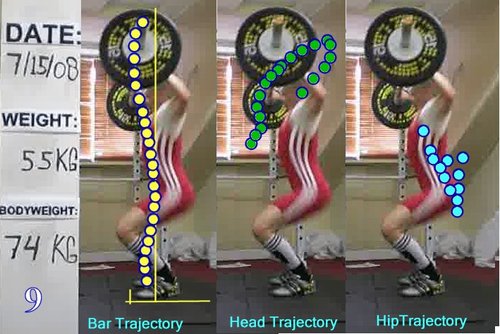
You could possibly read the lifter's mind by deciphering the trajectories
 of the motion of masses. The bar trajectory is pushed away from the body when the hips thrusted forward. If the head trajectory is rotated clockwise, to more horizontal plane, the bar could have passed over the groin and stayed on the initial vertical ascent when the hips thrusted.
To the contrary, the following photos shows a person lifting next to his bed and fish tank, which he ends breaking during the lousy biceps curling.

Note the casual curving of the spine during lifting which indicates the total lack of awareness of the proper lifting technique.

Now, the barbell is already gripped from the floor while the back is still hunching. Visualize this lifter after 20 years from today!! In fact, this sort of ignorant lifting is more damaging than good. Muscles are not the primary target of strengthening, the bone posture is. Say lifting in such poor posture is better than getting hooked on other bad things, right? Wrong. Look at Smorenburg's unconditional commitment to perfecting his posture in his home-gym.
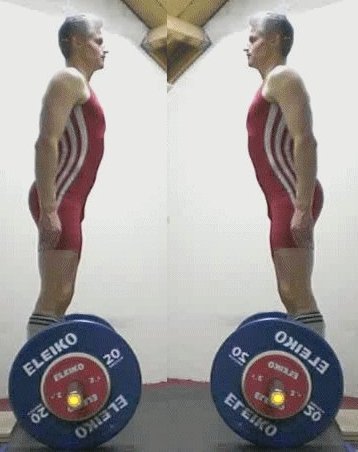
Smorenburg is a father of two, Floor and Jeop, and works as a train engineer for over three decades. Yet, in his fiftieth, Smorenburg could maintain perfect posture under resistance.

Here, goes the fish!!
The fish tank broke during the least demanding curling of the biceps.

God gracious. It is just the fish that got hurt.
Smorenburg has to worry about avoiding head concussion during the high speed overhead Snatch. Smorenburg transformed his attic into such lively Olympic Weightlifting Laboratory by the simplest means of searching, reading, posting on the Internet, and later, traveling to meet with me in search for deeper insight.

Subscribe to:
Comments (Atom)